

Thermocline
👇 Get new sketches each week
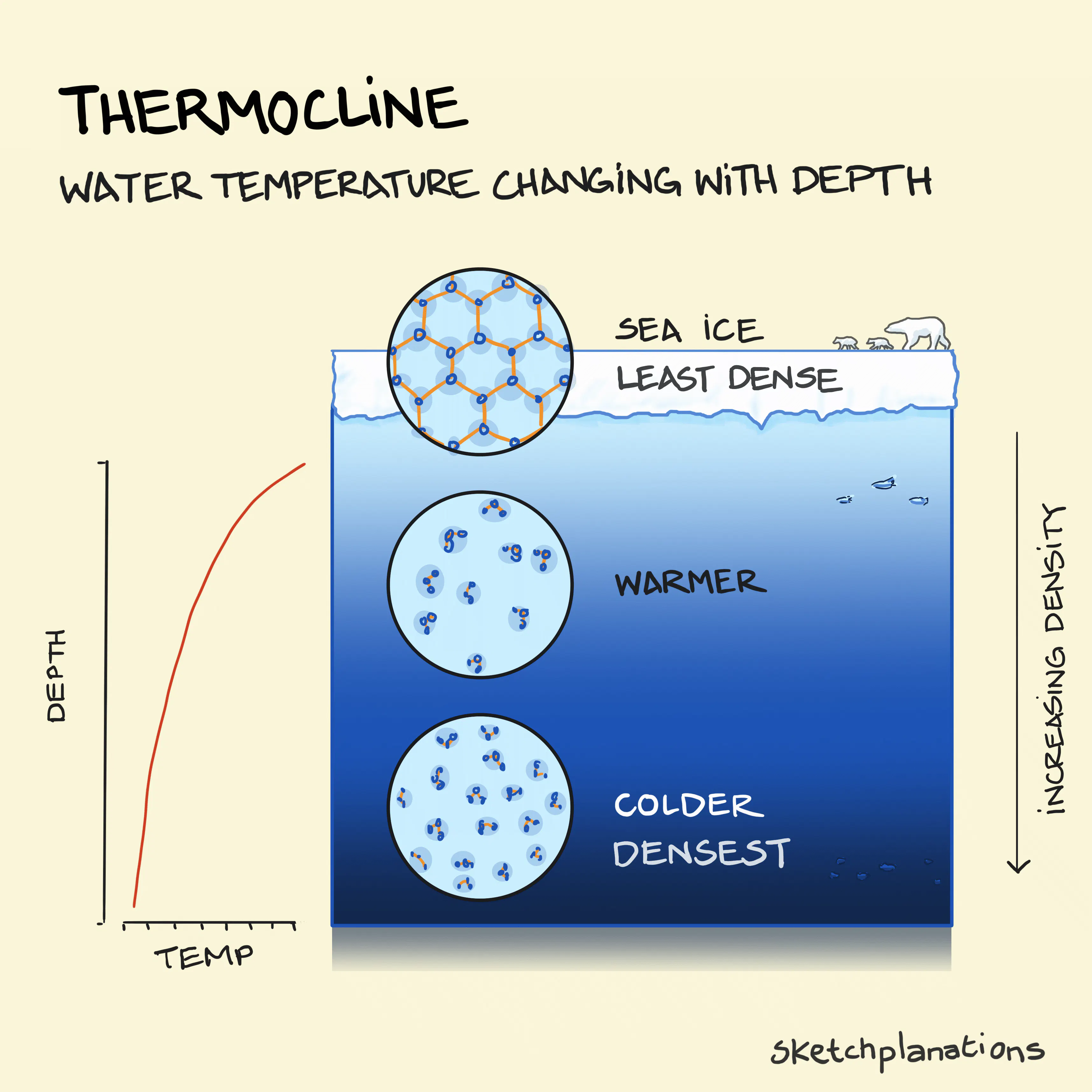
Perhaps, like me, you’ve tried diving down towards the bottom of a lake and noticed how after the first few metres, the water quickly drops in temperature. It has been a personal joy to test this in mountain lakes. Even just a few metres down, the water can be much colder than at the surface. This temperature gradient is a thermocline.
In the ocean, the thermocline is the zone below the surface mixed layer where water temperature decreases rapidly with depth. Because cooler water is denser than warmer water, the deeper water is typically denser than the warmer surface water.
The thermocline tends to have a greater temperature difference in tropical and temperate latitudes, and in the summer, when the surface layer is heated more. In the polar regions, thermoclines are much weaker.
Thermocline comes from thermo-, for temperature or heat, and -cline for slope, lean or bend—along with incline (bend towards), decline (turn aside), recline and others.
Thermoclines and Ocean Layers
Changes in temperature, salinity, and density lead to layers in the oceans. Ocean layering has important and far-reaching effects. Deep water may be doing something quite different from water at the surface. And areas where density causes water to rise or sink help drive ocean currents. In some cases, cold water at the bottom may be travelling in one direction, while surface water driven by winds may be travelling in the other direction.
NASA Goddard created a beautiful visualisation of ocean currents at different layers that’s well worth a 5-minute watch.
The three main ocean layers are the surface layer, sometimes known as the mixed layer, the thermocline, and the deep ocean.
- The surface layer gets heated by the sun. Mixing by winds and waves distributes the heat.
- Underneath, the thermocline is where temperature changes significantly with depth. The thermocline usually begins tens of metres below the surface and can extend to around 1000 m.
- In the deep ocean, at the bottom, temperature and salinity tend to change little. Most of the oceans’ water is down here.
And sea ice, being less dense than water, floats on the surface.
Haloclines and Pycnoclines
Also affecting ocean layering is salinity—how salty the water is. Salty water, as well as colder water, is denser than fresh water and so will tend to sink beneath it.
Ever since the incredible “underwater lake” in BBC’s Planet Earth , I’ve been meaning to sketch a halocline, the change in density when fresh and salt water meet.
Fresh water entering the North Atlantic from Greenland’s ice sheets reduces the density of surface waters. This may, in turn, weaken the sinking that helps drive major ocean circulation patterns.
A pycnocline is a density gradient, often caused by changes in both temperature (thermocline) and salinity (halocline).
Related Ideas to Thermocline
Also see:
- Know your poles — polar bears or penguins?
- Why ice doesn’t sink
- Topography and bathymetry
- Mirage — light bends as it passes through air at different densities
- Moon pool
- Latitude or longitude
- Buoyancy — how mega ships float
- Parallax — different layers moving at different speeds
Once, when swimming across the stunning Lake Sils in the Engadin Valley in Switzerland, an upwelling of ice-cold water from the bottom of the lake took my breath away. Just when I had decided that I couldn’t swim further, I arrived out the other side of the cold water back into the, relatively, warmer surface water. I thanked my lucky stars.
Thermocline can refer both to a temperature gradient in water and to the specific ocean layer where that gradient is strongest. I’ve tried to discuss both here, not just the layer.
I created this sketch for a series on oceanography with the brilliant team at the American Meteorological Society .