


Latitude and Longitude: How to Remember Which is Which
👇 Get new sketches each week
Latitude and longitude together give you your position on the globe. They are the two types of lines that wrap the planet on globes and our world maps. One set is the horizontal lines, and the other vertical, but for the longest time I struggled to remember which was which. No more.
How to Remember Latitude vs Longitude
The mnemonic I've found that has never failed for me to remember which is latitude and which is longitude is:
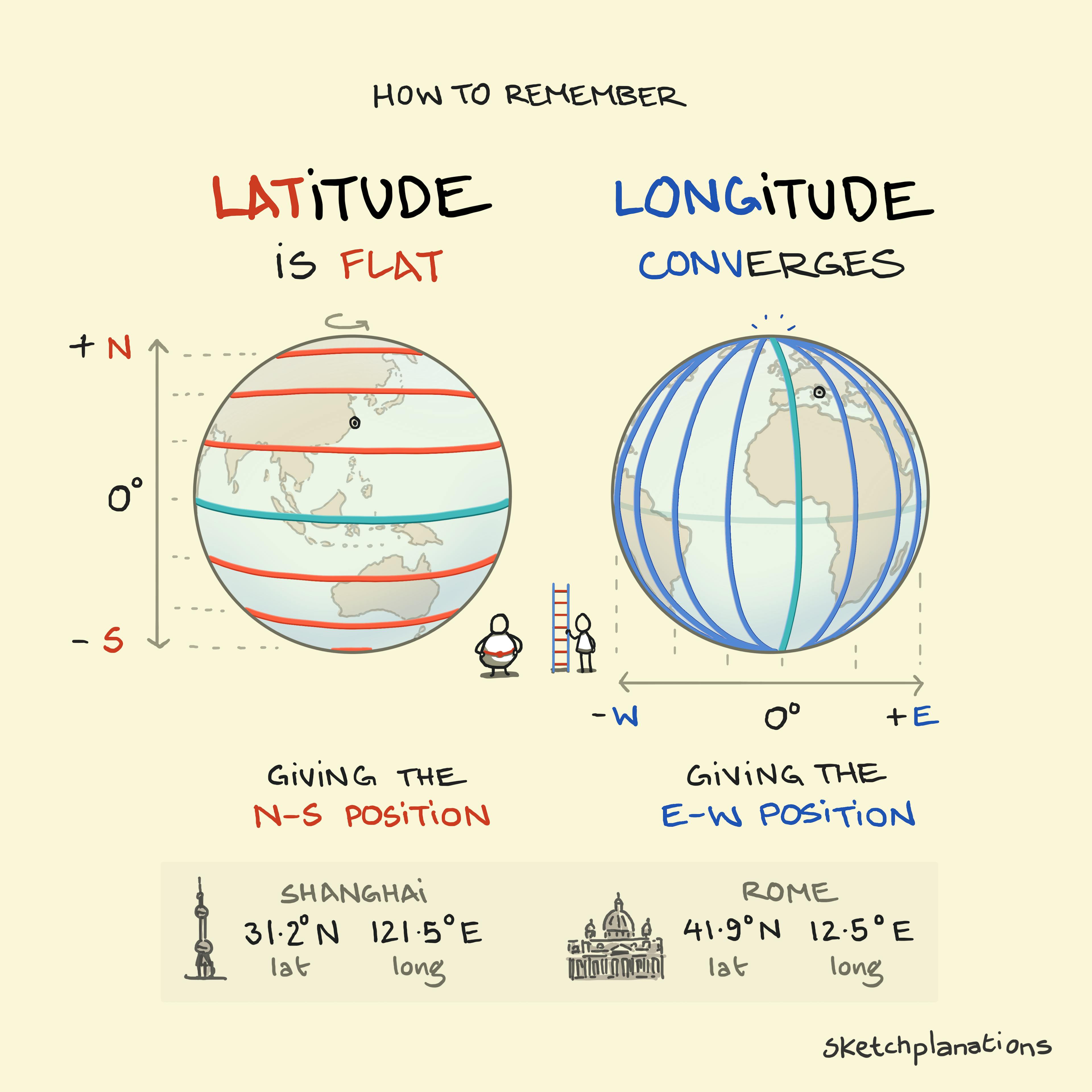
- Latitude is flat. (or just Lat is flat)
- Longitude converges.
So lines of latitude are the lines that lie flat on a globe or map. Lines of longitude are the tall ones that converge at the poles (latitude lines don’t converge).
Two other ways that might work for you:
- Imagine the map grid as a ladder. Latitude lines are the flat rungs you could step on, and longitude lines are the long vertical lines connecting the rungs.
- Longitude lines are always long, as they all pass through the poles. Whereas latitude lines, as they encircle at different positions north-south around the planet, are long by the equator but short around the poles.
Which Way Latitude and Longitude Run (and What They Mean)
When you give a latitude for a city or location, you're saying which of the horizontal lines of latitude the location is. Somewhat counterintuitively then, this tells you how far up or down the planet you are between the poles—your north–south position.
Latitude behaves like the y position on a graph. Latitude values increase as you go north from the equator and decrease as you go south.
When you give a longitude, this corresponds to which of the tall vertical longitude lines you mean. Longitude tells you where you are east–west around the world.
Longitude behaves like the x position on a graph. Longitude values increase as you go east from the prime meridian at Greenwich in London, and decrease (-ve) as you go west.
So:
- Lines of latitude are horizontal, but latitude gives you your vertical position (y position)
- Lines of longitude are vertical, but longitude gives you your horizontal position (x position)
Which comes first: latitude or longitude?
Most consumer tools like Google Maps write coordinates as lat, lon. An easy way to remember which comes first is alphabetical: latitude, then longitude—a then o.
So a GPS coordinate typically corresponds to your latitude (north–south) first and your longitude (east–west) second. Watch out for this if you, like me, are used to thinking of coordinates as x, y—horizontal position first, then vertical position.
Although many consumer tools use lat, long, some technical formats use long, lat, so it’s always worth checking. It can be a real pain if you travel to the wrong location.
A Lat/Lon Example
To take a real coordinate example. The coordinates for The British Library in London, written in the way Google Maps expects (latitude, longitude) are:
51.53005,-0.12765
That is 51.53005 degrees north of the equator, and just a tiny bit west of the Greenwich Prime Meridian.
You can type this into a search in Google Maps or Apple Maps to go straight there giving you:
https://www.google.com/maps?q=51.53005,-0.12765
And you can see the GPS coordinates for any point on Google Maps by right-clicking.
Other Ways that may Help to Remember
A number of readers told me how they remembered it. Perhaps one of these will work for you:
- One reader told me what solved it for them was the Corona ad: change your whole lattitude
- From the Jimmy Buffett song, "Changes in Latitudes, Changes in Attitudes" . Picture yourself going further south towards the equator and the warmer it gets the happier you become. Works every time.
- Latitude lays
- Lat = Fat = Wide = horizontal lines
- Lines of LATitude run LATerally.
- lonGitude = oranGe because of the wedGes
- Latitude, like altitude—kind of like going "up" the globe
- LAtitude - Lines Around the world. LOngitude - Lines Over the world
Summary
An easy way for how to remember latitude and longitude:
- Latitude is Flat — the horizontal lines on a map
- Longitude converges — the north-south lines that converge at the poles
- As a ladder: Latitude are the flat rungs, longitude are the long rails of the ladder.
- A latitude coordinate is which of the latitude lines you are on, your north–south position on the planet.
- A longitude coordinate is which of the longitude lines you are on, your east–west position on the planet.
- Coordinates in most consumer mapping tools are written as lat/long.
Hope that helps you, like it helped me.
PS
A mnemonic, pronounced nuh-MON-ik, is a technique that helps you remember something more easily.
Related Ideas to Remembering Latitude Longitude
Also see: