Understanding El Niño
👇 Get new sketches each week
The 3 Phases of the El Niño-Southern Oscillation
I expect you have heard of El Niño. Huge parts of the world, if not all of us in some way, are affected by El Niño, or, more completely, the El Niño-Southern Oscillation (ENSO). ENSO is a weather pattern that varies over a period of years. From typical conditions, to El Niño (the boy), the warm phase, to La Niña (the girl), the cold phase.
ENSO includes changes in both the atmospheric and the tropical Pacific Ocean. It includes variations in sea surface temperatures, rainfall, air pressure and atmospheric circulation. El Niño refers mainly to the ocean warming pattern, while the Southern Oscillation describes accompanying shifts in atmospheric pressure and circulation.
Now, El Niño always seemed complicated to me, and I never really understood it. But with El Niño on the horizon, and wonderful content from the American Meteorological Society, I wanted to try to explain the basics.
El Niño is complex and varied, and the effects are widespread. I don’t profess to cover everything here. ENSO does not follow a perfectly regular cycle. Events vary in timing, strength and duration, and not every El Niño is followed by a La Niña. As George Box said: All models are wrong, but some are useful.
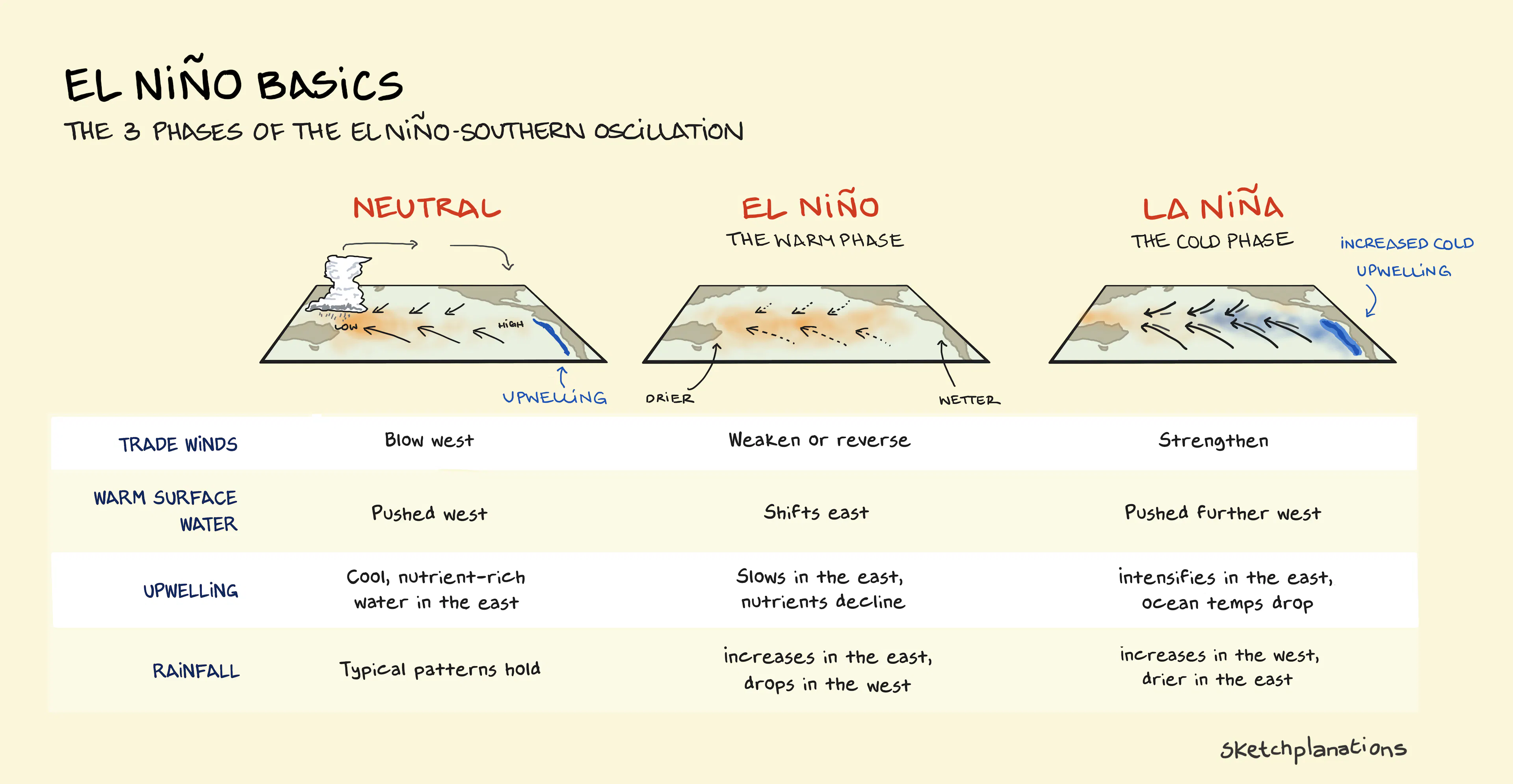
Because El Niño is a change in the normal conditions, to understand it, I think you need to understand how it’s different from normal. So here, and in the sketch, I focused on the three phases: Neutral, El Niño and La Niña.
The Neutral Phase - typical conditions
In typical patterns, between El Niños, trade winds push warm surface waters in the tropics of the Pacific Ocean to the west. All this movement of warm water leads to strong evaporation, low pressure and high rainfall in the western Pacific towards Indonesia and Australia. It also raises the sea level in the western Pacific compared to the east. These patterns of winds, rainfall and rising and sinking air across the Pacific are part of what is called the Walker Circulation.
At the same time, the western movement of surface waters creates an upwelling of deep water by South America, particularly along the coast of Peru. This upwelling provides nutrients that feed phytoplankton, which feed vast numbers of fish and, in turn, support major fisheries. The colder water is associated with higher pressure and drier conditions along the coast of Peru.
El Niño - The Warm Phase
El Niño is known as the warm phase because the warm surface waters spread east towards South America. This happens because the trade winds blowing westward weaken or even reverse. As the trade winds weaken, the slope in sea level across the Pacific relaxes, and warm water spreads east and suppresses the upwelling that supported the marine life near Peru.
Rainfall decreases in the western Pacific causing dry spells or drought. The fish stocks decline along the coast of Peru. And with the reduction of Peru’s typical high-pressure system, rainfall there often increases causing flooding.
Because the Pacific Ocean is so large, some El Niños cause weather changes in monsoon rains, the poles, Europe, Africa, and as far north as Alaska.
La Niña - The Cold Phase
Sometimes, after warm water spreads east during an El Niño event, conditions swing back strongly the other way—with stronger trade winds and increased cold upwelling. With the difference in sea level across the Pacific, I think of it a bit like a giant slosh in a bathtub.
In La Niña conditions, the trade winds strengthen, pushing warm waters further west. High pressure often develops along South America, and the cold upwelling increases. Warmer water around Indonesia and Southeast Asia intensifies the low pressure, resulting in high rainfall and often flooding.
Strong El Niños
Because the El Niño phase spreads warmer sea surface temperatures across a larger area of the Pacific, it often coincides with warmer-than-normal global average temperatures. Strong El Niño events can increase the risk of drought, flooding, heatwaves and wildfires in different parts of the world.
Does this give you a better idea of it?
More about El Niño
The differences in low and high pressure for the Southern Oscillation are sometimes measured as the difference from normal between Darwin (Northern Australia) and Tahiti (in the central south Pacific) .
Why is it called El Niño?
El Niño, Spanish for the boy, actually corresponds to Christ, as it was first noticed by South American fishermen around Christmas.
The Walker Circulation
The trade winds and rainfall patterns behind ENSO are part of a larger atmospheric circulation called the Walker Circulation. I sketched that separately, too, as it varies during Neutral, El Niño and La Niña phases. You can see it in the newsletter for this sketch .
Related Ideas to El Niño
Also see:
- Seasons
- Know Your Clouds
- Latitude and longitude: which is which?
- Weather and Climate, an analogy
- Thermocline
- Thunder Clouds
- Time hierarchy - fast and slow layers for robust, adaptable systems
- Temperature scales: Celsius and Fahrenheit
- All models are wrong, but some are useful
Read more
I learned about ENSO, El Niño, La Niña, the Walker Circulation and others from some oceanography textbooks. Find it in Chapter 7 of Introduction to Ocean Sciences 5th edition by Douglas Segar , the AMS Ocean Studies textbook, and the soon-to-be-released open-access Introduction to Ocean Sciences 6th Edition .