


Fast Pool, Slow Pool
👇 Get new sketches each week
Have you ever heard, maybe when watching a swimming event on TV during the Olympics, the commentators say that it’s a fast or slow pool? I was baffled! How can a bunch of water be fast or slow? But there's both science and practice in it, and a fast pool can make the difference between a good swim and a great one.
After researching different factors and quizzing a former Olympic swimmer who actually builds swimming pools (The ReCreation Group ), here's what I learned about what makes a pool fast.
What is a Fast Pool?
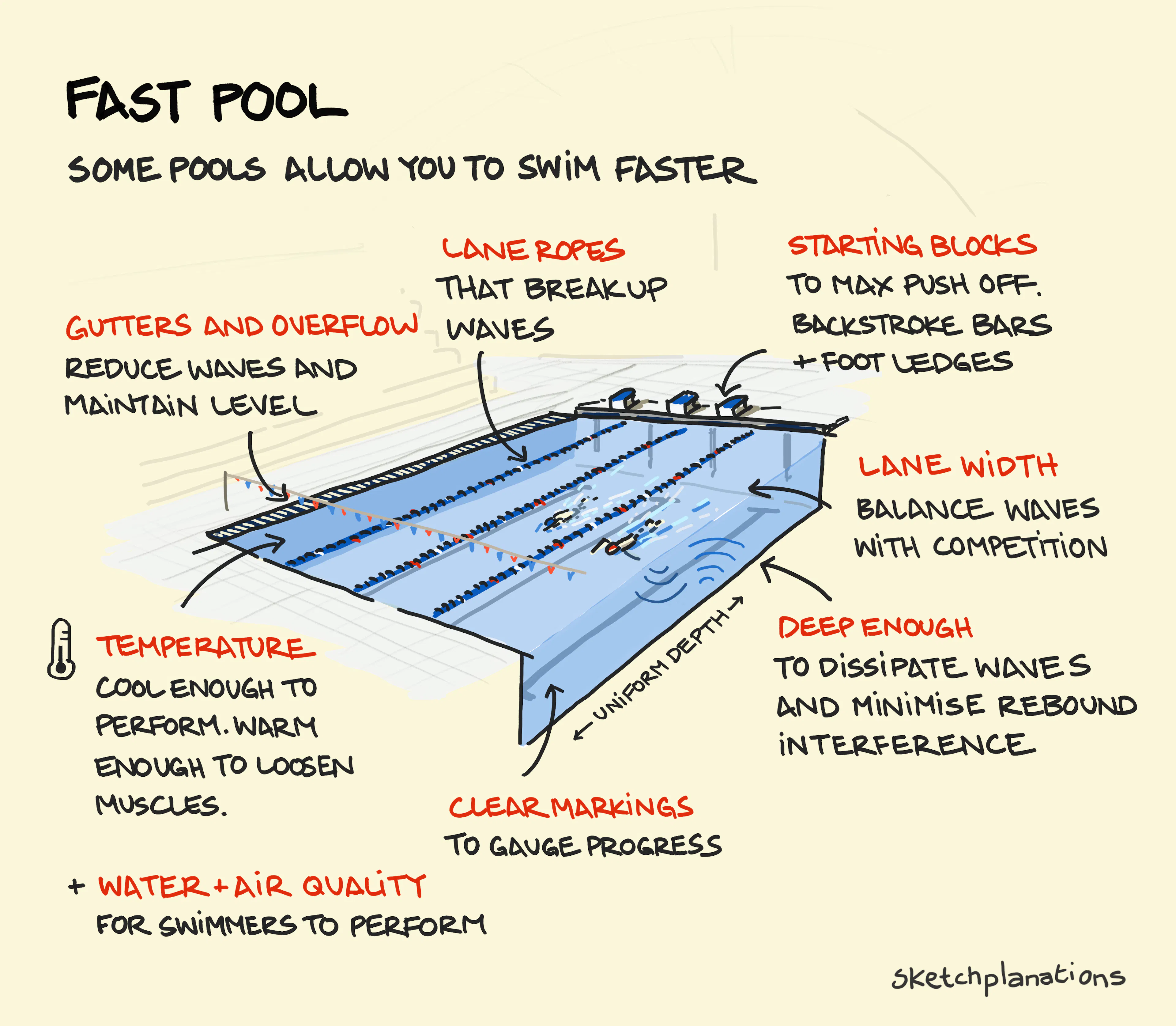
A fast pool is one where swimmers can achieve their fastest times in competitive events.
Many factors contribute towards a pool being fast or not. Here are the main ones.
Reducing Waves
Waves caused by swimmers can rebound off lane dividers, the pool floor, and the sides, slowing a swimmer's progress. Fast pools have designs that account for these to minimise drag, resistance and general interference from waves.
Pool depth
In shallower pools, waves rebound off the bottom and back into the swimmer's path. Deeper pools allow waves to dissipate, and rebounded waves might arrive back at the surface after the swimmer has passed.
Depth is also a balance between the psychological benefit of clear line markings for visible speed reference points on the bottom.
A uniform depth, rather than a sloping bottom, say, may also avoid unwanted turbulence.
Effective gutter and overflow design
Waves rebound off the sides of the pool, interfering with swimmers in the outside lanes. Leaving the outside lanes empty can help if there is space.
High-sided pools reflect waves into the pool, so fast pools tend to have the water level at the poolside. Waves above the pool level can wash over into the gutters. Effective gutters are deep enough to absorb these waves while maintaining the overall water level of the pool.
Some pools also manage waves at the ends that swimmers swim towards. Some have overhangs with gutters underneath the starting blocks or even latticed or perforated walls to let water through.
Anti-wave lane ropes
Within a swimmer's lane, waves bounce off the lane ropes. Well-designed lane ropes can break up waves, minimising rebound and interference with other lanes.
Temperature
The ideal water temperature should be cool enough that swimmers aren't working harder against the heat, yet warm enough that their muscles aren't tight. Typically, this is around 25–28 °C (or 77–82 °F).
Water Composition and Air Quality
Maintaining the proper chemical composition of the water and fresh air in the pool arena both impact a swimmer's ability to perform at their best. One measure is Total Dissolved Solids (TDS) (skin cells etc <yuk>). In principle, a higher % TDS is more viscous and can slow swimmers down.
Starting block design
Starting blocks give swimmers the fastest possible starts. Some improvements include fins for the back foot to allow maximum spring without slipping on dives. And to help backstroke swimmers spring off effectively, you can fit bars to grip and a foot ledge.
Psychological effects
It's not just physical factors that influence speed; some aspects have a psychological influence. These include clear markings on the bottom of the pool, or above for backstroke swimmers, to allow swimmers to gauge their speed. And lane width is also a balance between reducing waves and feeling the competition of adjacent swimmers.
A Slow Pool?
That's the opposite. Imagine:
- a shallow pool rebounding waves from the bottom
- no clear markings
- lane ropes that amplify waves
- high sides to the pool that send waves back to the centre
- too hot or too cold
- too stuffy, too chemical
- too wide or too cramped
- no starting blocks
No records here.
Not swimming your fastest? Now you have lots you can blame it on.
Related Ideas to Fast Pool, Slow Pool
Also see: