
Melody and Harmony
👇 Get new sketches each week
Two simple ideas at the heart of music: melody and harmony.
I had a general awareness of both of these, but came across this wonderful, clear distinction:
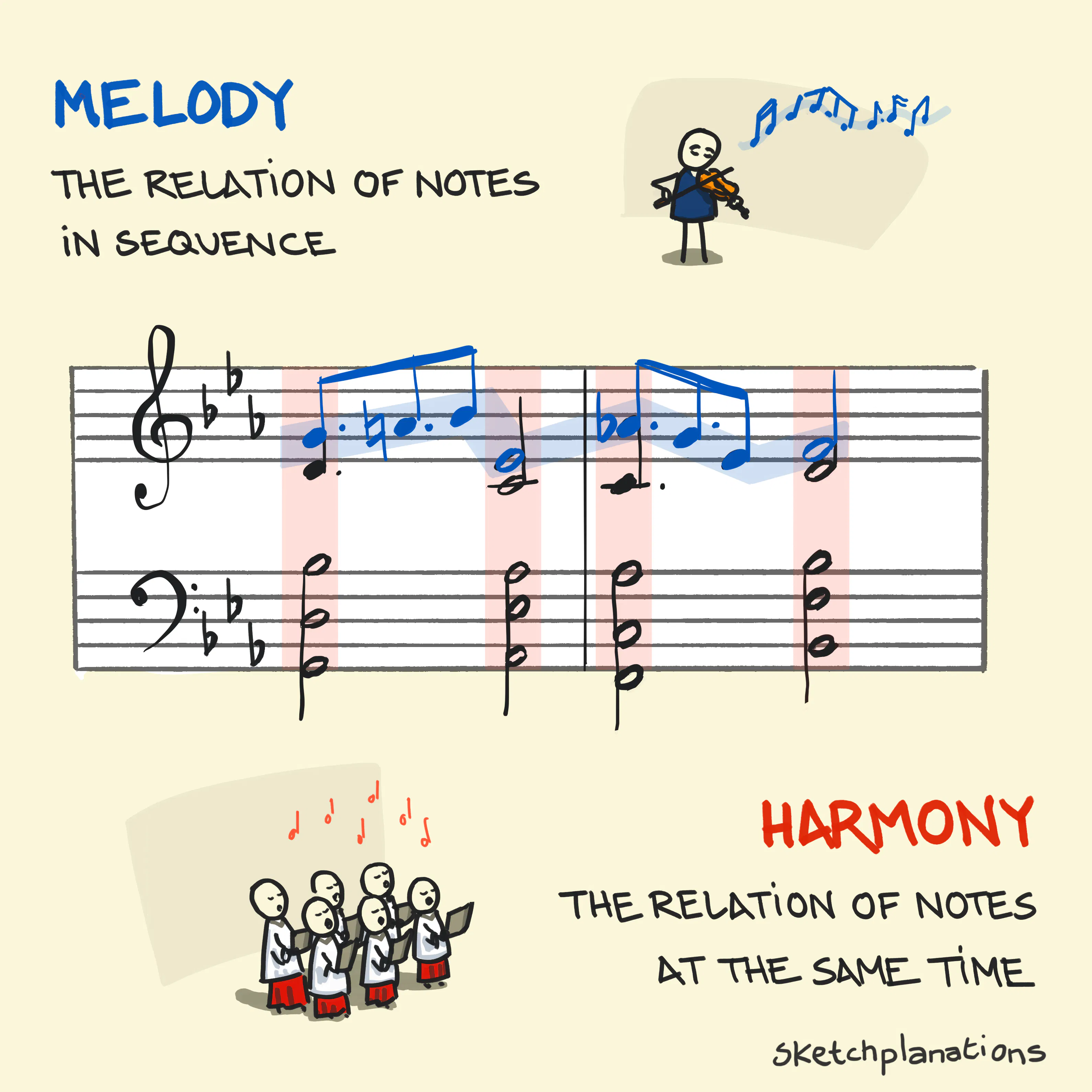
- Melody is the relation of successive notes.
- Harmony is the relation of notes sounding at the same time.
In other words, melody is about notes over time; harmony is about notes together.
The simplicity of melody and harmony makes them beautiful metaphors for so much. If your life is in harmony, the different parts fit together well. The melody may be the journey or story of your life over time. Melody is like a line and harmony the landscape.
The example in the sketch is a simplified passage from Let Go - Reprise (sheet music ) on my piano EP Deep Down and Not Forgotten .
Melody
Melody is simply how we interpret a series of notes heard in order. A linear succession made up of pitch and rhythm.
As in this example, melody is often the top notes of a piano part. But a melody could be in the middle, or you can have multiple melodies running simultaneously.
It’s remarkable to me that what we call melody we pick out automatically from the mass of sound over time. A good melody can stay with you for life.
I don’t know how our brains process this, but I distinctly remember, as a teenager, the sudden realisation that the way we hear and interpret the sound of a note depends entirely on the preceding sounds. I found this particularly striking in Shostakovich’s beautiful Piano Concerto No. 2, which has both beautiful melodies and harmonies. I tried to recreate the effect—much less successfully—in my piano piece The Space Between , the artwork of which is based on my sketch of the Japanese concept Ma: the role space plays in your art.
Harmony
Harmony is the relationship between sounds heard at the same time. It’s nice when these sounds go together well, but technically harmony doesn’t have to be harmonious.
Harmony has both a vertical dimension of different notes (or frequencies) stacked together and a horizontal dimension as those sounds change over time.
In the sketch, the left-hand notes (on the bottom set of lines) with the red background are held for longer than the notes in the melody and so actually sound at the same time as the blue notes connected by the bars. So the blue notes also become part of the harmony. In my piano music, I use the pedal a lot, which sustains the sound of notes, and create harmonies by layering multiple notes over time.
--
As with chess, I find myself in awe of the incredible diversity of combinations it’s possible to create from the simple ideas of melody and harmony.
I came across the simplicity of the distinction in Autobiography of a Yogi where he writes:
“Melody is the relation of successive notes. Harmony is the relation of simultaneous notes.” Simple.
Related Ideas to Melody and Harmony
Also see: