
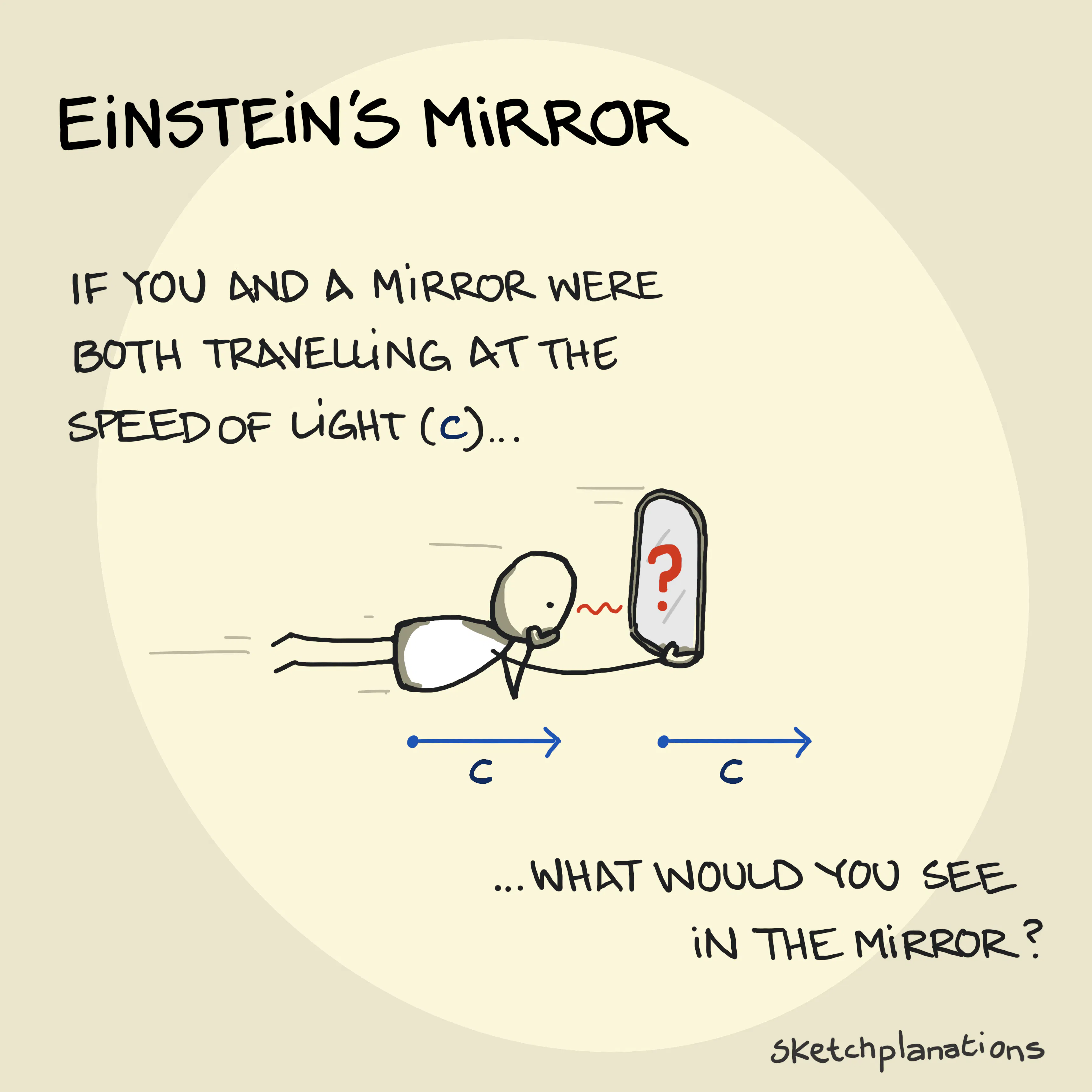
Einstein's Mirror
👇 Get new sketches each week
What would you see if you tried to travel alongside a light wave at the speed of light? And suppose you held a mirror in front of you as you zipped along. What would you see in the mirror?
This and similar thought experiments were posed by the young Albert Einstein to himself in his teens. It’s come to be known as Einstein’s Mirror and is also the title of a popular book on relativity.
It would at first seem that light, reflected off your face, could never reach the mirror to, in turn, reflect back into your eyes to see it. So what would you see?
It was only years later that Einstein developed a theory that answered this puzzle. And it required some fundamental adjustments to how we understood the world, which still bend my mind to think about them. These include:
- You can’t travel at the speed of light.
- Time is not fixed; it is relative.
- The speed of light is a universal constant—it is the same, independent of the motion of the source.
Einstein wrote:
“After ten years of reflection, such a principle resulted from a paradox upon which I had already hit at the age of sixteen: If I pursue a beam of light with the velocity c [the velocity of light in a vacuum], I should observe such a beam of light as a spatially oscillatory electromagnetic field at rest. However, there seems to be no such thing…”
- Autobiographical notes, 1949
I’ll try to explain a little as I understand it.
Our usual experience is that velocities are additive. Suppose I am on a moving train carriage and I throw a ball from the back of the carriage to the front. For an observer outside the train, that ball moves at the speed of the train plus the speed of the ball relative to me. But light behaves differently.
As you approach the speed of light, the energy required to keep accelerating approaches infinity. In effect, you can’t reach the speed of light. So an observer of a flying Einstein wouldn’t see light travelling from him to the mirror at twice the speed of light. What changes is time.
For the high-speed Einstein, the light would appear to travel away from him to the mirror and back at its usual immense speed. However, for an observer, what would only seem a moment for the high-speed Einstein might take years for the rest of us—the experience of time changes with velocity.
It’s a remarkable turn for a simple and fascinating question. It’s amazing to me that the young Einstein would both pose this question, continue work on it, and then think to question some of the most self-evident facts of our world as we experience it: that time is not fixed, that a speed cannot be reached, and of course, ultimately, that energy is matter.
The book Einstein’s Mirror is co-authored by my Dad (respect!). It’s full of photographs, fascinating stories, and the characters that moved physics forward. It includes the people, events and science central to another of Christopher Nolan’s films, Oppenheimer . Perhaps Christopher read it 🤔
Related Ideas to Einstein’s Mirror
Also see:
—
Earlier this year, we attended a showing of Christopher Nolan’s Interstellar at the Royal Albert Hall in London with Hans Zimmer’s soundtrack played by a live orchestra. It was a fantastic way to experience a remarkable film—a film that manages to make black holes, wormholes, and time slippage both understandable (largely) and part of the plot. It strikes me as an astonishing achievement for a mainstream film.