

Dune Types: Transverse, Linear, Barchan, Star Dunes
👇 Get new sketches each week
Sand dunes can be beautiful and awe-inspiring. And, though they come in infinite shapes and sizes, specific combinations of winds and sand together create common dune types. I find it interesting to try to recognise the basic types and why they form in the way they do.
Here are some of the most common dune types.
Transverse Dunes
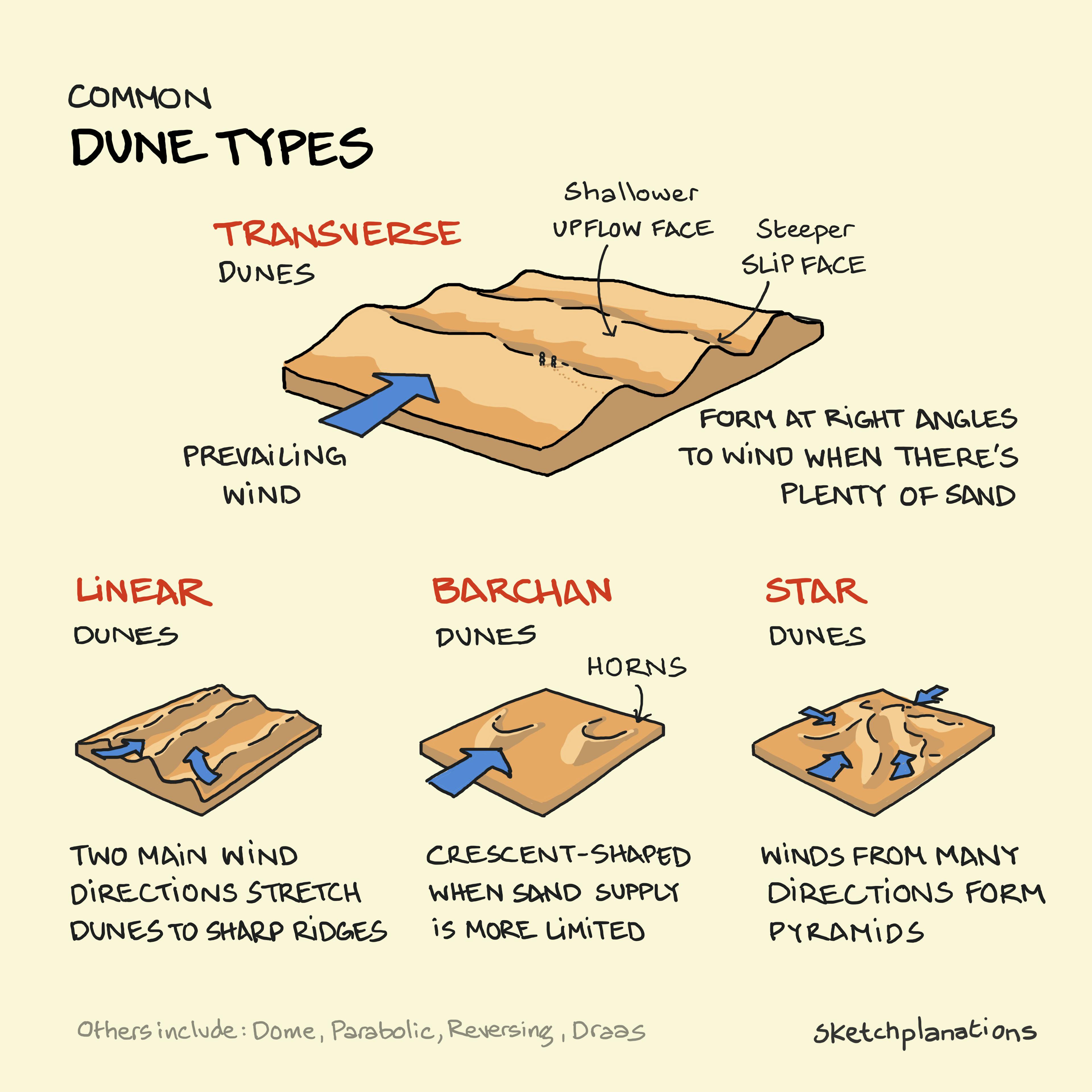
Transverse dunes form, somewhat counterintuitively for me, perpendicular to the wind direction. It’s rather like how a dirt road washboards perpendicular to the direction of traffic, and ripples on the beach will often form at right angles to the wash of the waves.
When there’s plenty of sand and the wind is predominantly from one direction, sand begins to pile up and creates sheltered depressions on the other side of growing dunes. The sheltered zones help set up fairly consistent spacing between dunes. It’s fascinating to observe both at a tiny scale on the beach and flying over a vast desert.
Transverse dunes typically have a shallower up slope in the direction the wind arrives from and a steeper slip slope on the sheltered side. I learned that the shallower upface is called the stoss side, and the steeper slipface is called the lee face.
Linear Dunes
When wind blows from two directions, dunes can be pulled into long, linear ridges, forming longitudinal dunes or linear dunes. The ridges align with the average direction of the wind. Some ridges can run for a hundred miles.
In contrast to transverse dunes, wind from both directions creates slip faces on both sides, often forming sharp edges along the dune ridges. This leads to the more poetic name of seif dunes, meaning sword in Arabic.
Barchan Dunes
When the prevailing wind is from one direction and sand is less plentiful, crescent-shaped barchan dunes form. They have characteristic horns extending in the direction the wind blows.
Sands are always shifting, and barchan dunes can move relatively quickly along the desert floor compared to other large dunes.
Star Dunes
When winds blow from many directions, sand can get blown into dunes that grow vertically in a star or pyramid shape. Remarkably, they can reach up to 500m tall. In some areas, star dunes form along longitudinal ridges.
Other Dune Types
The interactions of sand and wind are endlessly complex, and other types of dunes exist. These include:
- Dome dunes, without prominent ridges, as you might imagine
- Parabolic dunes, which look like barchan but face the opposite way. Look out for these near the coast.
- Reversing dunes, which have a sort of mini-dune facing the opposite way at the top of the ridge.
- Draas: mega-dunes sometimes made up of other dune forms.
Related Ideas to Common Dune Types
Also see: