

The Volcanic Explosivity Index (VEI): Comparing Eruptions
👇 Get new sketches each week
Volcanoes are big, so eruptions are big. But how big? And how would you compare one eruption with another? Well, like the Richter Scale for earthquakes, there’s a scale for eruptions. It’s called the Volcanic Explosivity Index.
What Is the Volcanic Explosivity Index?
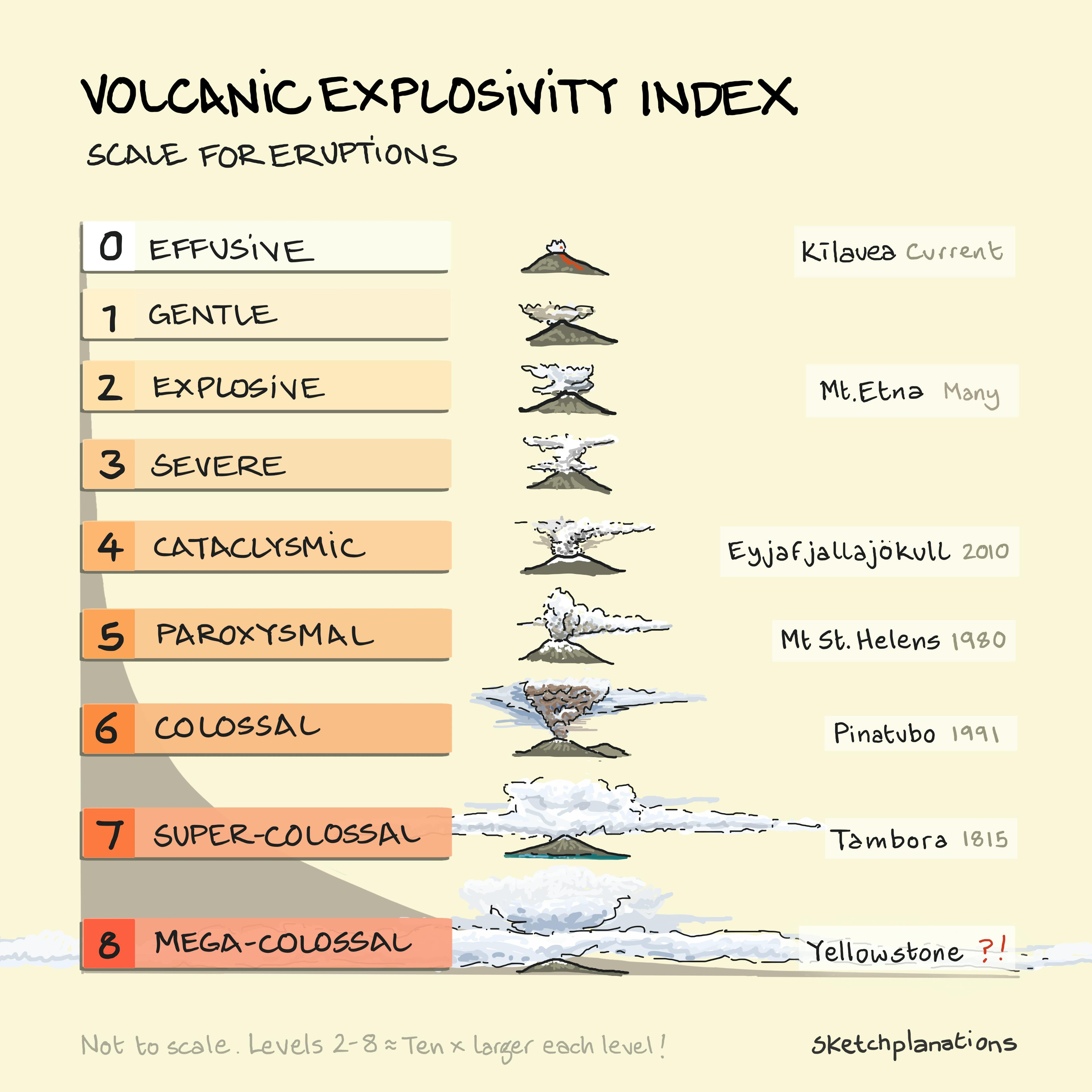
The Volcanic Explosivity Index (VEI) ranges from 0 to 8. It covers everything from a shoot of ash with a trickle of lava (Effusive), for example, Hawaii’s Kīlauea volcano, to the mega-colossal explosions in the distant past from the Yellowstone caldera, the largest supervolcano in North America.
Volcanoes erupt in different ways, and the index uses several measures, such as the volume of ash (tephra) ejected and the height and scale of the plume and ash clouds. And some eruptions are sudden, while others go on for years.
Because of this difficulty in classification, one division I like is red volcanoes and grey volcanoes. A red volcano is an effusive eruption with lava and often a lava lake, like Hawaii’s Kīlauea. A classic grey volcano eruption is Mt St Helens that created an ash cloud rising to around 15 miles above the summit.
Like the Richter scale, the Volcanic Explosivity Index is a logarithmic scale. This means that, after the first levels, each level ejects roughly ten times more material than the previous(!)—hence the sketch not being to scale.
Volcanic Explosivity Index and Example Eruptions
Here’s the scale with associated adjectives, approximate sizes of the eruption column, and some example eruptions you may have heard of:
0 · Effusive or Non-explosive
100m, Kīlauea (Hawaii, current)
1 · Gentle/Mild
100m–1 km
2 · Explosive
1–5 km, Mt Etna (Italy, 2006 and many others)
3 · Severe
3–15 km
4 · Cataclysmic
10–25 km, Eyjafjallajökull (Iceland, 2010)
5 · Paroxysmal
20–35 km, Mt St Helens (USA, 1980), Vesuvius (Italy, 79 AD), Hunga Tonga–Hunga Haʻapai (Tonga, 2022)
6 · Colossal
>30 km, Pinatubo (Philippines, 1991), Krakatoa (1883)
7 · Super-colossal
>40 km, Tambora (Indonesia, 1815), Santorini (Greece, 1600 BC)
8 · Mega-colossal
> 50km (uncertain, though massive), Yellowstone (USA, several times...)
On a personal note, some of my favourite places in the UK are the museums in South Kensington, London. The Earth galleries in the Natural History Museum are always fascinating and inspiring. I learned about the volcanic explosivity index there and had been meaning to sketch it for at least ten years.
The descriptive adjectives for each level vary slightly across the sources I’ve seen. In particular, levels 4 and 5 are sometimes 4 Catastrophic and 5 Cataclysmic. But I liked the labels the Natural History Museum uses, including Paroxysmal.
Learn more about the VEI
The USGS (United States Geological Survey) have a helpful article on the VEI from geophysicist Michael Poland.
And you can read the original 1982 paper that proposes the scale from volcanologists Chris Newhall and Steve Self: The Volcanic Explosivity Index (VEI): An Estimate of Explosive Magnitude for Historical Volcanism (archived pdf), Journal of Geophysical Research
Related Ideas to the Volcanic Explosivity Index
Some more scales:
- The Fun Scale
- The Bortle Scale — Clarity of the night sky
- The Scoville Scale — Chilli heat
- Temperature scales — Fahrenheit and Celsius
- Solar System Sizes
- Time hierarchy
- Dunbar’s Number
More volcanoes: