

Moravec's Paradox
👇 Get new sketches each week
On the capabilities of machines and people
In his 1988 book Mind Children , Austrian robotics researcher Hans Moravec, wrote :
“…as the number of demonstrations has mounted, it has become clear that it is comparatively easy to make computers exhibit adult-level performance in solving problems such as intelligence tests or playing checkers, and difficult or impossible to give them the skills of a one-year-old when it comes to perception or mobility.”
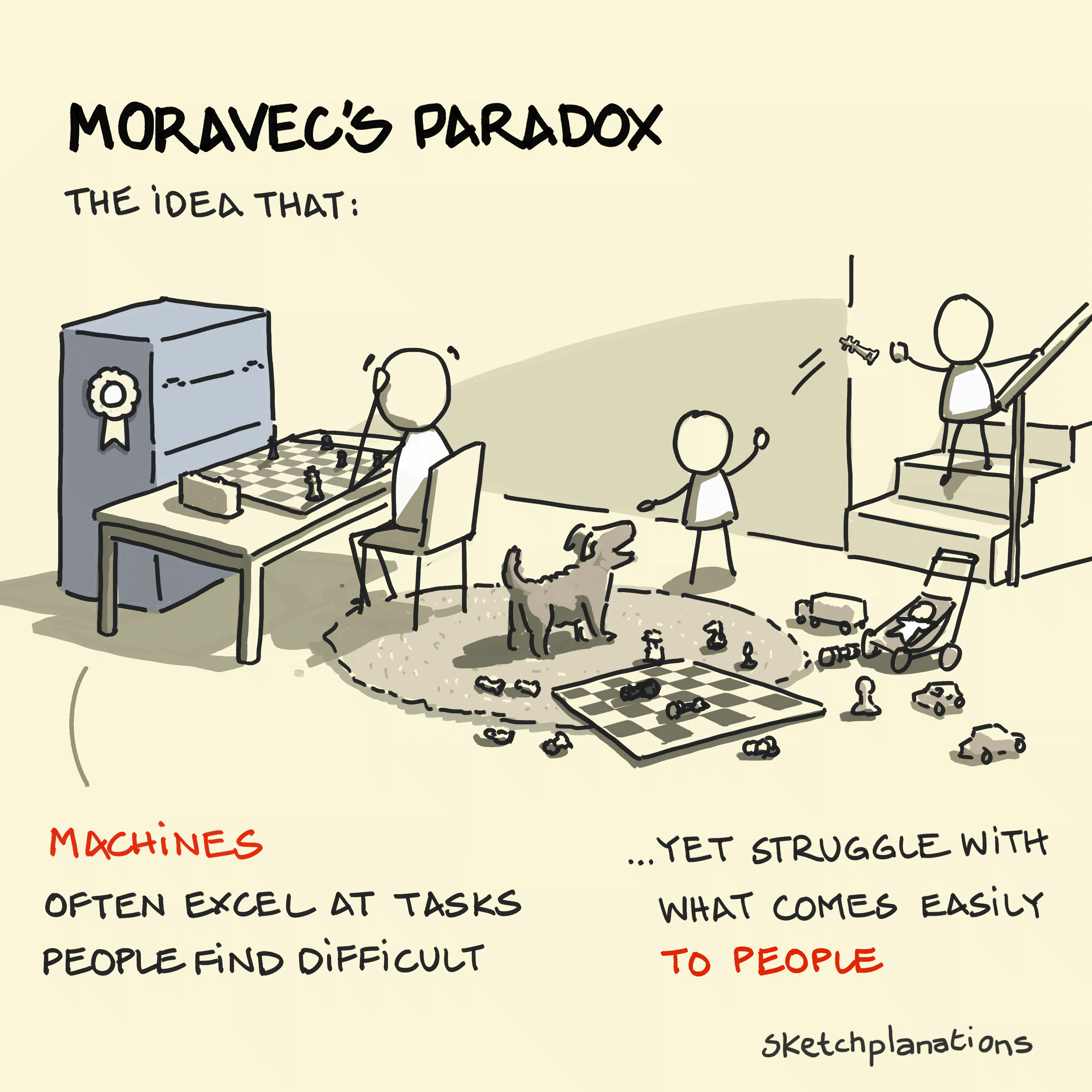
This surprising pattern became known as Moravec’s Paradox, the idea that machines often do well at things people find hard, and do poorly at what is easy for us.
As classic examples:
- We consider chess grandmasters to be among the most intelligent people on the planet, yet computers eventually triumphed over them.
- A young child can (in principle) place raspberries gently on a plate, stack glasses in a dishwasher, read a friend's emotions, crawl up some stairs, or play with a dog, and yet our machines still find this hard.
It sounds rather reasonable.
That Google Maps can, in seconds, provide me with an optimised walking route between places hundreds of miles apart is a source of consistent amazement for me. Yet it’s challenging for a self-driving car to understand if a traffic official is gesturing for it to slow down, something I find effortless.
Yet some of the traditional examples of Moravec’s paradox now feel dated. As Hans said, “Unfortunately for humanlike robots, computers are at their worst trying to do the things most natural to humans, such as seeing, hearing, manipulating objects, learning languages, and commonsense reasoning.” Machines have now made great strides in most of these.
Princeton Computer Science Professor Arvind Narayanan, thinks Moravec’s Paradox is neither useful nor true .
Yet UC Berkeley Robotics Professor Ken Goldberg cautions that robotics still faces a “100,000 year data gap .” He explains that the extraordinary capabilities of models that produced the AI capabilities we all know are created from the internet-scale amount of image and text data we already had available. He calculated that it would take a person 100,000 years to read or view all the data that we had ready to feed into our AI models.
In contrast, we have comparatively little data ready to use for applying similar techniques to, say, robot dexterity. He advocates an approach where we make robots that are functional enough to be useful, and use these for data collection to improve, much as Waymo have been doing with self-driving cars for over 15 years.
What do you think?
Related Ideas to Moravec’s Paradox
Also see:
- The Automation Paradox: the better the machines get, the more we struggle when they fail
- Fauxtomation: claims of automation for work actually done by people
- Cognitive offloading: delegating our thinking
- Jevon’s Paradox: Fuel efficiency gains tend to increase, not decrease fuel use
- Chaos monkey
- Looking under the Lamppost
- More paradoxes
Ken Goldberg’s view on robotics at UC Berkeley News, Aug 2025