

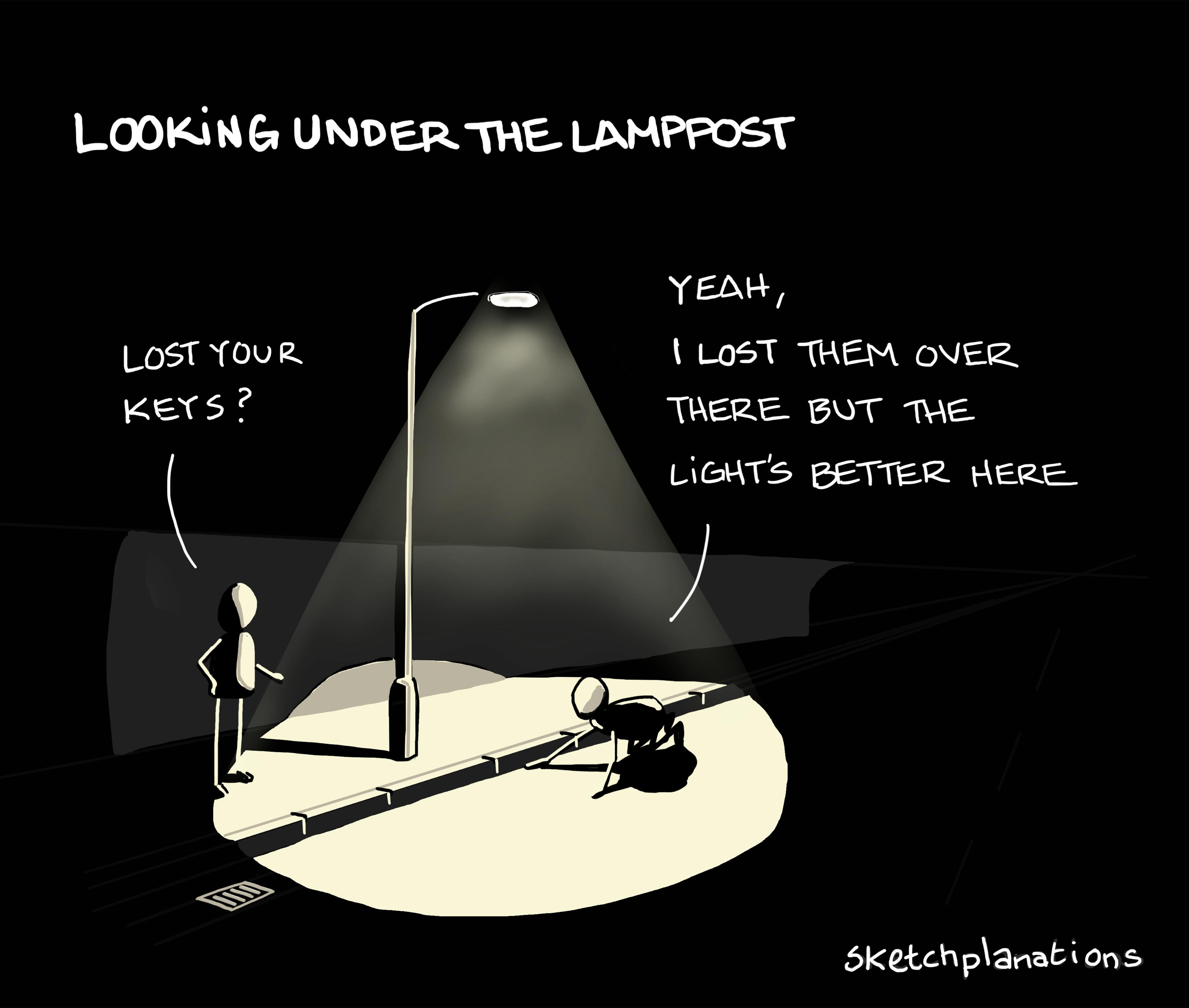
Looking under the lamppost: the Streetlight Effect or the Drunkard's Search
👇 Get new sketches each week
It's an old economists' joke:
A person out walking at night comes across a man scrabbling on the floor under a lamppost. The man on the floor says he lost his keys.
When asked when he dropped them, he replies, "Oh, I dropped them over there, but the light's better here."
The joke is also known as The Streetlight Effect , the Streetlight Problem or the Drunkard's Search.
It's an apt metaphor for how, if we're honest with ourselves, sometimes we find ourselves working, searching, or staying where we find it easier rather than where we know we ought to be.
Examples of streetlight problems
Streetlight problems abound. Here are some examples of where we might find ourselves looking under the lamppost instead of where the best answers are.
- Improving metrics that are easier to track or that you're measured on (see Goodhart's Law) such as page views or clicks rather than things that matter more such as customer satisfaction or long-term outcomes.
- Running studies using datasets that are easy to gather rather than better data that is harder to gather.
- Optimising an existing product because it's known and does well, rather than trying riskier new products.
- Focusing on exam scores when things like curiosity, love of learning, confidence, job prospects, are harder to measure.
- Counting calories because they are easy to track, while ignoring diet quality, sleep, stress, and habits that matter more but are harder to change.
- Improving productivity rather than addressing root causes and focusing on the most important problem.
- Adding automation where data is clean and structured even if the biggest inefficiencies lie elsewhere.
- Reducing screen time for kids rather than addressing what they're doing on screens.
- Arguing about chores or tidiness because they are concrete and measurable, while the real tension is about expectations, fairness, or emotional load.
I'm sure you can think of many more. In each case, the light is better where we are looking—but what we're trying to fix lies out of the light, somewhere darker, less convenient, and harder to reach.
A test you can try: If the light moved, would you still be looking in the same place?
Related Ideas to Looking Under the Lamppost
Also see: